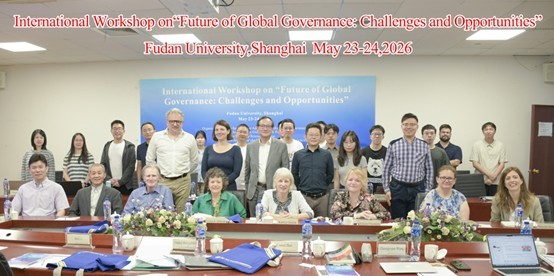
From May 23-24, 2026, an international workshop on “Future of Global Governance: Challenges and Opportunities”, co-organized by the Fudan Institute for Advanced Study in Social Sciences (Fudan IAS), Institute for Global Public Policy (Fudan IGPP) and the Editorial Board of Chinese Political Science Review and Fudan Journal of the Humanities and Social Sciences, was held in Fudan University. More than twenty scholars from China, the United States, the United Kingdom, France, Italy, etc. attended the workshop.
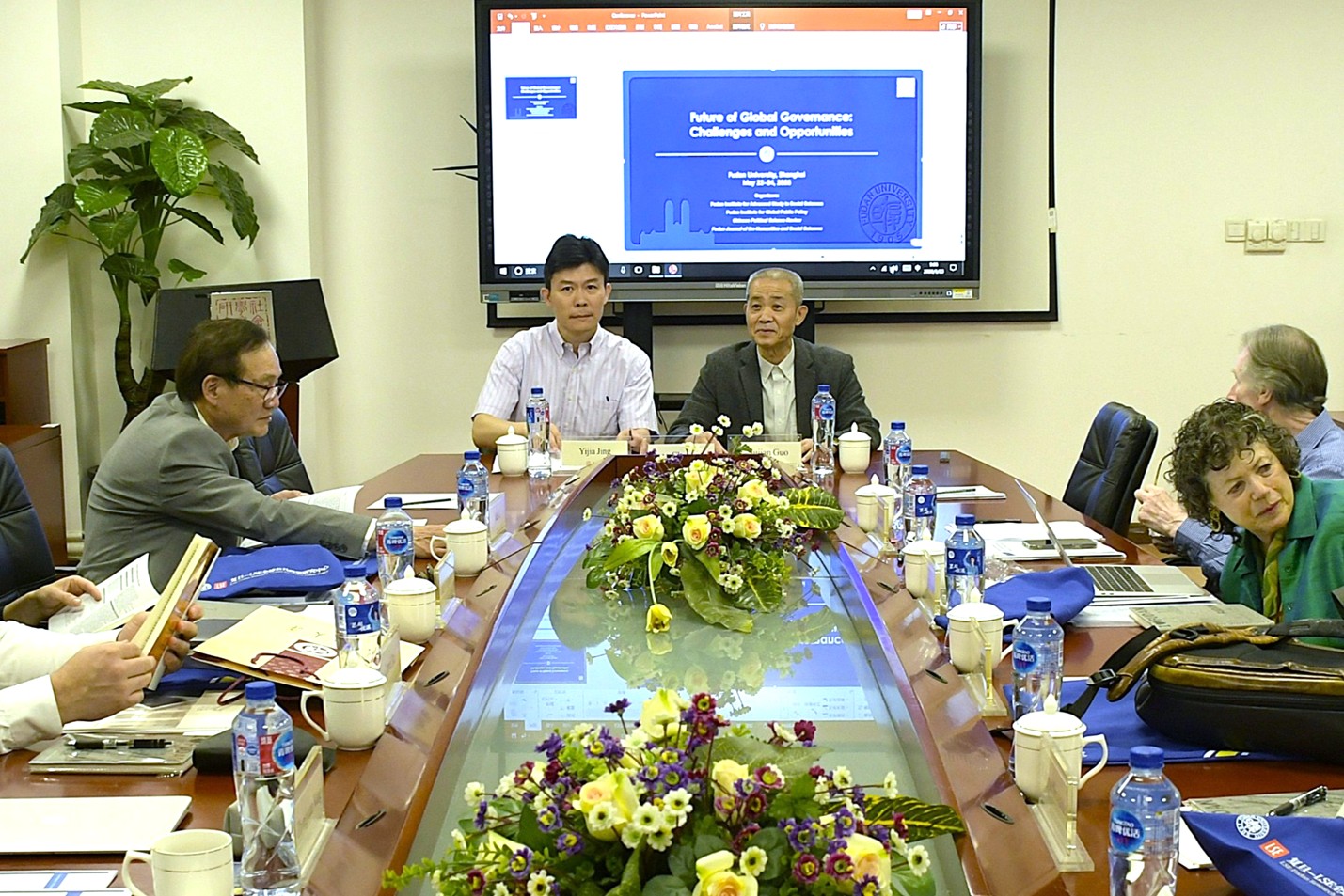
Professor Sujian Guo, Dean of Fudan IAS, Changjiang Distinguished Professor and Editor-in-Chief of Chinese Political Science Review and Fudan Journal of the Humanities and Social Sciences and Professor Yijia Jing, Dean of Fudan IGPP, Changjiang Distinguished Professor and Editor-in-Chief of Global Public Policy and Governance, delivered the opening remarks respectively. They each provided an overview of their respective institutions, welcomed the scholars in attendance and wished the workshop a complete success.
The first session of the workshop, titled “Reconstructing the Vision of a New World Order”, was chaired by Professor Vivien A. Schmidt, Professor Emerita at Boston University, fellow of the American Academy of Arts and Sciences and visiting scholar at Fudan IAS.

Professor Jolyon Howorth, Professor Emeritus at University of Bath and visiting scholar at Fudan IAS, delivered a presentation titled What’s in a Word? American IR Experts Struggle to Identify the “New World Order”. Professor Kathryn Sikkink of Harvard University, fellow of the American Academy of Arts and Sciences, delivered a presentation titled Global Governance, International Law, and Wars of Aggression.
The second session of the workshop was focused on “Disruption and Dis/continuity in Global Governance”. Professor Sikkink chaired this session.

Professor Vivien A. Schmidt talked on Political Challenges to the Global Order. Professor Laura E. Sjoberg of the University of Oxford delivered a speech titled (Anti)Gender Politics at a Global Crossroads.
Professor Sjoberg then chaired the third session “Adjust Costs and Global Justice in Planetary Politics”.

Professor Kalypso Nicola?dis of the European University Institute made a speech on Who Adjusts? Citizen Power, Planetary Politics, and the Recasting of World Order. Professor Cornel Ban of the Copenhagen Business School talked on Europe’s Real Energy Trilemma in a World of Petrostates and Electrostates.
The fourth session of the symposium “The Sovereignty Dilemma and Power Structures in AI Governance was chaired by Professor Manuela Moschella of the University of Bologna.

Professor Jieli Li from Ohio University delivered a presentation titled Liquid Authority in Global AI Governance: Sovereignty Divides and the Emerging Role of Big Tech Corporations.
Professor Zhongyuan Wang from Fudan IAS made a presentation on Compute Sovereignty, Great Power Competition, and the Future of Global AI Governance.
The fifth session of the workshop focused on “Institutional Resilience and the Stability of Global Economic Governance” and was chaired by Professor Jolyon Howorth.

The final session of the workshop, titled “The Global Knowledge Production and Technology,” was chaired by Professor Kalypso Nicola?dis of the European University Institute.

Associate Professor Meijun Liu of Fudan IGPP delivered a presentation on Relatedness Constrains Novelty but Strategic International Collaboration Buffers This Penalty in Global SDG Research. Associate Professor Weizhan Meng from Fudan IAS talked on The Paradox of Order in the Age of Artificial Intelligence.

At the end of the workshop, Professor Sujian Guo, on behalf of the organizers, thanked the scholars for their excellent presentations and in-depth discussions. He noted that the papers submitted by the participants would be published as special issues in the Chinese Political Science Review and Fudan Journal of the Humanities and Social Science and expressed his hope for further, long-term academic exchanges and collaboration with the scholars in the future. The workshop concluded successfully amid warm applause from all the participants.